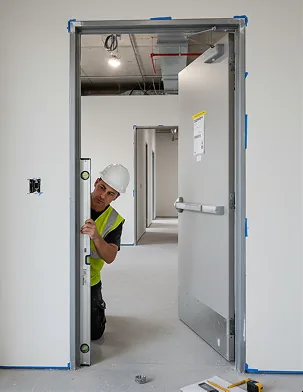
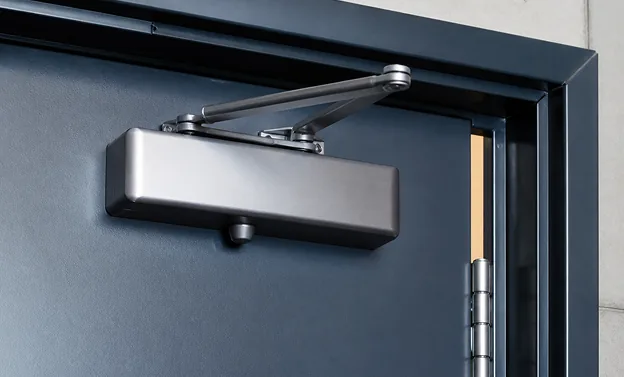
Acceptance testing that supports a cleaner project closeout.
AES evaluates newly installed fire and smoke door assemblies, documents observed deficiencies by opening, and coordinates findings with the project team before turnover and AHJ review.
Review of installed fire and smoke door assemblies.
Opening by Opening Records
Findings organized for corrective work.
Closeout Support
Documentation for project and owner teams.
Field Labeling
On-site field-labeling evaluation for eligible fire and smoke door openings.
CREDENTIALS & STANDARDS
Defined scope from installation through closeout.
AES works with general contractors, construction managers, Division 8 teams, installers, suppliers, and owner representatives to coordinate acceptance testing around the project sequence.
Defined Opening Scope
Confirm applicable buildings, floors, opening quantities, identifiers, and required documentation.
Site Readiness
Coordinate installation status, access, safety requirements, site contacts, and inspection windows.
Acceptance Testing
Evaluate the agreed fire and smoke door assemblies after installation or alteration.
Opening-Level Records
Document observed conditions by opening so responsible project teams can coordinate follow-up.
BEFORE PROJECT TURNOVER
Each opening needs a clear record.
A general statement that doors “passed” or “failed” does not give the project team enough information. AES organizes findings by opening, location, and observed condition.
Installed Assembly
Review the visible condition of the door, frame, glazing, and applicable components.
Operation and Hardware
Evaluate closing, latching, coordination, and installed hardware as included in scope.
Gaps and Clearances
Document observed alignment, perimeter clearances, and other applicable conditions.
Labels and Modifications
Record visible labels, field preparations, damage, alterations, or unverified conditions.
AES documents observed conditions. Corrective work is determined and completed by the appropriate contractor, installer, supplier, design professional, or other responsible party.
PROJECT MILESTONES
Inspection support aligned with the construction sequence.
Acceptance testing is easier to coordinate when applicable openings, project documents, readiness requirements, and turnover milestones are identified before the final inspection window.
Reviewing available plans, schedules, and opening quantities
Confirming field identifiers and inspection phases
Coordinating installation readiness and site access
Evaluating the agreed installed assemblies
Issuing findings organized by door or opening
Coordinating phased or multi-building inspection windows
Returning for re-evaluation when separately scoped
AES provides documentation that can support punch-list coordination, owner turnover, and preparation for TCO, CO, or AHJ review. Final approval remains with the applicable authority.
Illustrative structure only · exact fields and deliverables are confirmed during scoping.
WHAT YOU RECEIVE
Clear findings, organized by opening.
Your report documents the agreed inspection scope, the openings evaluated, and the observed findings. It gives facility, construction, and AHJ stakeholders a clear record for review and follow-up.
Agreed inspection scope
Applicable visual and functional checks
Findings organized by door or opening
Observed deficiencies documented
Reporting for facility, contractor, and AHJ review
CLIENT FEEDBACK
Clear findings. Better closeout coordination.
Feedback from the contractors and project teams AES supports.
“AES coordinated acceptance testing with our project schedule and documented each observed condition by opening. The report gave our team clear location references and practical information for assigning corrections and preparing the affected assemblies for follow-up review.”
John Doe
Project Manager or Superintendent
“AES coordinated acceptance testing with our project schedule and documented each observed condition by opening. The report gave our team clear location references and practical information for assigning corrections and preparing the affected assemblies for follow-up review.”
John Doe
Project Manager or Superintendent
“AES coordinated acceptance testing with our project schedule and documented each observed condition by opening. The report gave our team clear location references and practical information for assigning corrections and preparing the affected assemblies for follow-up review.”
John Doe
Project Manager or Superintendent
“AES coordinated acceptance testing with our project schedule and documented each observed condition by opening. The report gave our team clear location references and practical information for assigning corrections and preparing the affected assemblies for follow-up review.”
John Doe
Project Manager or Superintendent
“AES coordinated acceptance testing with our project schedule and documented each observed condition by opening. The report gave our team clear location references and practical information for assigning corrections and preparing the affected assemblies for follow-up review.”
John Doe
Project Manager or Superintendent
START WITH WHAT YOU KNOW
Bring the facility or project context. AES will help define the next step.
Whether you are planning a recurring inspection program, acceptance testing, or a conversation about a specific opening, begin with the details you already have.
We use cookies to ensure our website works properly and to improve your experience. You can accept cookies or manage your cookie preferences at any time.
Essential Cookies
Always active
The technical storage or access is strictly necessary for the legitimate purpose of enabling the use of a specific service explicitly requested by the subscriber or user, or for the sole purpose of carrying out the transmission of a communication over an electronic communications network.
Preferences
The technical storage or access is necessary for the legitimate purpose of storing preferences that are not requested by the subscriber or user.
Statistics Cookies
The technical storage or access that is used exclusively for statistical purposes.Essential cookies are required for the website to function properly and cannot be disabled.
Marketing
The technical storage or access is required to create user profiles to send advertising, or to track the user on a website or across several websites for similar marketing purposes.